Showing posts with label gaming. Show all posts

Sunday, November 16, 2008

Harsh on the Wastelands

After about 20-30 hours of trying to play through Fallout 3 and becoming tremendously bored by some of the vague/tedious side quests, I wrote a hasty and harsh review of Fallout 3. Now, I've finished it, and I have to say: I was wrong.

I don't know why, but since watching WALL-E, way back, I've just been overly critical of all movies/games I've tried. It's ironic that it is not a horrible disappointment that led me to jadedness, but rather a true gem.

Anyway, concerning Fallout 3. Some of my previous complaints were valid. For instance, the original Fallout did better with its "talking heads" than Fallout 3 does with its fully 3D heads, mostly due to a lack of expressiveness and some crude lip-syncing at times. Oh, and it got pretty annoying that all Super Mutants and Ghouls sound exactly the same, but I suppose that's what happens when you have a game that requires voice acting for every single creature, rather than the select few in Fallout 1 and 2.

I've never been much for free-roaming environments. I tend to lose focus on the story and just go off on my own, likely never to return before I stop playing the game out of boredom. I was determined to finish Fallout 3 before Left 4 Dead was released, though, so I created a new character and started again, this time ONLY doing the main quest, and absolutely zero side quests. Meh, some side quests are neat, and I'm anxious to see where some threads lead, but I can do that later, when I get the urge. Right now, I just wanted to see it through to the end.

Doing the main quests I'd done before was, naturally, a drag, but things quickly livened up when the plot progressed to the point that I found myself in a virtual world (within a virtual world, of course). It just struck the right awesome string, broke the jadedness, and I loved it since, from super-AI, to huge, hulking robots. I finished the main quest of the game in under 12 hours, but it was a very satisfying experience, with multiple possible endings (though mine was a bit lame, as I'd done no side quests, and thus had few, if any, impact slides at the end [example | example -- Fallout 1 and Arcanum, respectively -- both include huge spoilers).

All-in-all, from what I've seen, it's a fantastic game. Very satisfying in its story and themes, all while remaining quite impressively true to its roots. Hell, the ending is much like Fallout 2's ending... but better, actually.

Wednesday, November 5, 2008

Demoing the New


Okay, after seeing all the good articles about Left 4 Dead on its fansite, I simply couldn't resist but buy it. Generally, I hate online games, but I get the feeling that I'll love this. I've got my demo all preloaded and ready for playing tomorrow, and I can't wait! I mean, look at this Valve genius:


Hopefully EA doesn't mess it up in some way. I love Valve, and have learned to hate EA. What happens when they combine?

Another game that looks like a buttload of fun, but unfortunately hasn't so far released a demo for PC (I hate it when consoles get special treatment) is Mirror's Edge. Just look:


Again, EA's tag. Let's hope that they don't screw things up like they seemed to with Spore.

UPDATE: Apparently, EA Games is only attached to Left 4 Dead because they sell the retail games, as opposed to the fully Steam-based online-purchased version (which is the one I preordered). Hopefully that means the fat slob known as EA won't get its greasy fingers all over a beautiful product.

Monday, November 3, 2008

Post-Nuclear FPSRPG


Though I've not yet played Fallout 3 all the way through (due to a combination of generally disliking the completely open-world style, family visiting, and faffing about in said open world), I can say from what I've seen thus far that it's certainly an entertaining little chip. Now, while I have been overly critical about it in the past, saying that the graphics are downright bad, in hindsight, I think that's a bit too harsh. Sure, some textures look like pixelated, blurry messes when you get up close, some walls/ceilings have odd texture mapping errors where a grain of metal, wood, or rust suddenly stops and continues on in a completely different direction, and the characters look about as lifeless and unrealistic as they can be in this video game generation, but overall, it's not bad. Hell, I have to admit that the wasteland looks amazing, and some of the effects (spoiler: like the destruction of Megaton) just make my mouth water.

On the other hand, thus far the game has mostly been about battles upon battles upon battles, which I suppose is the point. However, if I recall, most every battle in Fallout and Fallout 2 could be avoided if you said the right thing, had the right skills, or just ran fast enough, but here, combat is inevitable. At the best, your skills will help you activate a robot to assist you in clearing an area, but the robot can't handle it all on its own, it's just a weak assistant (in particular, I'm thinking of a certain Super-Mart level). Additionally, I was very disappointed with how little a lot of characters had to say, and, for those who did speak, how little of what they said was interesting or important. In Fallout 1 and 2, the world was populated by NPCs who would say little, if anything, with a few scattered important NPCs who had a lot of say, and usually a reason to say it (as in, it related to some quest or another). In Fallout 3, everyone has a few lines to jabber, but barely anyone has anything important to say, at least not directly.

Something that I'm not sure if I like or not would be the way that skills often don't guarantee success, like they seemed to in Fallout 1 and 2. For instance, if you have speech skill, it will give you a percentile roll. Even if you've got insane speech skill, unless your opponent is extremely weak-willed, it's not guaranteed to work. I guess this adds the same sense of urgency as, say, rolling 1 in Dungeons and Dragons, except that skill checks don't have auto-failures in D&D. I believe that, in Fallout 1 and 2, if you didn't have the necessary percent chance of success from a high enough skill, the option simply didn't show (though I could be wrong, and it could have been working with the percentile thing behind the scenes all along). What it amounts to is me saving before talking to an NPC, then reloading and reloading until I get the roll. Basically, it makes it pointless to crank up the skill, unless maybe it "unlocks" some options.

Which brings me nicely to my second point: skill ranks that just "unlock" minigames. In Fallout 3, your skill rank in things such as science and lockpicking simply determines whether or not you'll get a chance to pick a lock. In Fallout 1 and 2, your skill was represented as a percent chance of success, modified by the difficulty of the lock. Here, having one of the necessary tiers (25, 50, 85, etc.) will unlock your ability to play a minigame. In the case of lockpicking, you try to jimmy the lock with a bobby pin and screwdriver. At least that takes some concentration and can be done easily if you figure it out--if you start to jimmy and it doesn't look like it's working, stop right away and try another spot before the pin breaks off. It teaches you to use a light touch, which is nice.

However, when hacking a terminal, you have to guess what word is the password. Well, that's actually not correct, as none of the words are the REAL password, it's just a word randomly chosen when you enter the terminal. When you select a word, the terminal will tell you how many of the letters in that word are in the correct sequence. For instance, if the correct password is "boar" and I pick "four", it will tell me that 2 of 4 letters are correct. However, often the correct letters are something shared by most, if not all, of the words (like an "ing" ending), and you save time merely by guessing randomly. There's no real skill involved in this one, it's just blind luck, and it's annoying. Fortunately, you can exit out of the terminal before all four attempts are used, and it will give you another four chances, but with a whole new randomly generated series of words. Therefore, you never actually guess the real password (which would be helpful and fun, as you could do some guessing based on location, who own the terminal, etc.), but rather some word that may or may not be actually relevant.

Maybe it's a bit ironic that I like random chance rolls with skills, but not with persuasion, and, honestly, I don't mind the speech percent chance so badly. It's that damn hacking screen that really annoys me. And, on top of that, more often than not, most of the options on the terminal are useless (you get some error from the terminal, which I suppose is meant to make things seem realistically broken down, but it's just disappointing after all that work hacking it).

Another problem with the open-ended world is, like Oblivion, there are a lot of places which are essentially useless. Sure, there's usually something of some interest, but I feel like I'd rather have less areas with more detail and worth, rather than more areas that are basically good for nothing. Granted, it's not nearly as bad as Oblivion.

Speaking of not being as bad as Oblivion, I'm SO HAPPY that Bethesda finally removed that crappy stealing system from the engine! In Oblivion, if you steal something, anyone in the vicinity knows you've stolen, regardless of whether or not they saw you, and the generic item is tagged as stolen, so you can only sell it to special fences. Not in Fallout 3. Here, you can rob a store owner blind when they have their back turned, then sell the entire stock back. That is, until they run out of their limited supply of bottle caps (which apparently take forever to come back). You can do this without sneaking at all, as long as they didn't see you, and no one's the wiser. Maybe that's scaling their thief-awareness back a bit TOO far.

If I had to sum up my complaints with Fallout 3, I'd say that the game feels unfinished. There are a lot of loose ends, pointless crap, and boring bumbling about. At least there's a fast-travel system, but, like Oblivion, you have to find the place on foot first. What was wrong with a map system like Fallout 1 and 2, where, when told where someplace is, you'll get a pip on your map, which you travel to on the map screen, but there's a chance you'll hit some resistance along the way, or find a special area? I admire Bethesda's efforts in emulating the authentic "Fallout" feel, and in some ways they succeeded (in the same way that the newest Star Wars trilogy "kind of" feels like the classic one), but, overall, I'd say the game is overhyped and deserving of a 75 to 80% at most.

Don't get me wrong. Neither Fallout 1 nor Fallout 2 were perfect, but they had great atmosphere and fantastic interaction. Fallout 3, however, while it has some atmosphere, tries to make up for its lack of interaction with a lot of plain action. Sorry, Bethesda, but there's a limit to how sweet a death animation can be, particularly when all that happens is the limbs and head separate from the body. Besides, it's totally been done before. Look at The Suffering, to name just one.


Sunday, October 19, 2008

Ember and Payne

The general consensus is that City of Ember was a fairly poor film, scoring only 48% on Rotten Tomatoes. Of course, then again, Quarantine did far better, and, from what I hear, that's been rather overrated (according to The Spoony One's opinion, which I respect).


Personally, I thought that City of Ember was very good. The complaints are that it goes too slowly, there isn't enough action/adventure, etc., but it introduces the characters and opens the story in about the same way as the book, and, through it all, stays pretty close to the source material. If anything, it adds action/adventure that's not in the book to begin with. I'm a big fan of trying to keep movies as close to their sources as is possible, particularly avoiding reinterpretations of the source material. As someone said, "if you know you can't make it better, don't try."

On the other side of the coin, I'm planning to go see Max Payne tonight. It's been a long time since I played the game, but I recall very good things. The game was action-packed, had an interesting story, and did some fun and fascinating mindplay with psychological scenes like running down a hallway that stretches out longer and longer before you. From what I hear, the movie doesn't stick to the game at all, and that's an easy way to earn my criticism, but let's see how it actually turns out.

If you don't mind spoilers, go ahead and watch the game. It's pretty entertaining, and I love the comic book style of the cutscenes.

Friday, August 15, 2008

Dark Forces, Light Fun

A game that stands out as a classic in my mind is Star Wars: Jedi Knight: Dark Forces II. Yes, one hell of a title, but also one hell of a game. Borrowing the look and feel of Quake, Dark Forces II brought a semi-RPG element to the game, with two separate ways that one could go; light side or dark side, depending on one's actions (which really meant, depending on whether or not one pointlessly killed the harmless NPCs). Depending on which direction one went, they would become increasingly darker or lighter, and the live-action cutscenes would reflect this, either depicting you betraying your friends and taking over the galaxy, or defeating the bad guys for the good of all.


Speaking of the live-action cutscenes, that is something that the game was sometimes criticized for, but I actually liked them quite a lot. Sure, the CGI effects weren't exactly realistic, but I never had a problem with that (maybe I was just too young), and as far as the acting goes, unlike the Command and Conquer games, it wasn't at all bad. I've never been one for blaming bad acting, unless it's so outstandingly horrible you can hear the monotone in the actor's voice. No, the actors tried hard and did well, and it's fun to see the different paths that the game takes.


The game itself was a pretty typical FPS--walk through the linear levels and you'll find your goal. There are occasionally puzzles, like having to press a button to get somewhere, but I don't recall anything overly complicated. Though the game was truly 3D, it didn't actually use much in the way of shading technology, so a level was often only as dark as its textures, which usually wasn't that dark. "Dark Forces 2" was a pretty bright, primitive game, but damn was it fun. Also,if you swing your lightsaber right, you can cut off the stormtroopers' arms! Bad-ass.

  • Windows 95

  • 90 Mhz Processor

  • 16 MB RAM

  • PCI Video Card

  • 16-bit Sound Card

If you'd like to have a taste of this great classic, I recommend the demo, which allows you to play through the first level.
Star Wars Jedi Knight: Dark Forces II Demo

Wednesday, August 13, 2008

Stupid En Masse

Roleplaying games are some of my favorite. I love feeling like I've made meaningful choices that have positively (or negatively, depending on how I like my character) affected the universe. It's a little chance for a real-life nobody to feel like a virtual somebody. Unfortunately, everyone else shares that same feeling.

The difference between a CRPG and an MMORPG is that, in the former, you, the player, are special in that you're the hero. Your choices affect the world around you, and everything can be bent around your pinky, should you so desire. It's all about you, and the world reflects that. In contrast, MMORPGs try to tell everyone that they're special and have that same power, but when everyone is special, no one is special, making everyone insignificant.


Of course, that doesn't even touch on the biggest reason that MMORPGs fail: people are stupid. Now, although I don't play MMOs at all, I have played roleplaying games with excellent multiplayer capabilities, and the problems are all the same. If there aren't enough people, it's boring because, unlike single player, you create your own story (or else, like in World of Warcraft, everyone repeats the same monotonous quests), and you need others to do that. On the other hand, if there are too many people, then you're plagued by people who don't care about roleplaying and just want to either be annoying or make a mess out of everything everyone else has created.

Maybe I'm a prick elitist for enjoying what I call "roleplay" by making up some character and playing him without interruption from the real world through a game, but it seems to me that most who enjoy a roleplaying game, whether it be single player, multiplayer, or MMO, agree on what it is they want: a fully customizable avatar that they can live through and interact with, as opposed to a lifeless mass of polygons to complete grindtastic quests and kill hundreds of look-alike baddies through.

What's worse is that there are tons of just such boring games that exist (and require regular monthly fees), with even more on the way. A friend of mine spoke highly of one such game, Star Wars Galaxies, that, while innovative and fascinating with open-ended true roleplay gameplay, a player-run world, and a non-standard level up system, quickly turned into what he called a "WoW clone", taking out all reason to really work towards any goals because the game hands you your cake and pats you on the head without any effort on your part like a lazy toddler trying to get through America's education system.

Maybe MMORPGs will change one day, but I somehow doubt it, as each new step towards something better, as was the apparent case of Star Wars Galaxies, seems to fall back into the same crippling hole. Sure, maybe the lack of individuality (or personality, for that matter) is a credit to the game for some, and maybe the repetition and static quests are lauded in gaming circles, but while all the other horses break their legs on prairie dog hill, I'll be perfectly happy prancing around in the thriving green meadows of single-player CRPGs. At least there, the only annoying person I have to endure is me.

Wednesday, August 6, 2008

The Irradiated Future

As has been established, I love 30s to 60s culture. I'd have to say it's because of the almost childlike hopeful attitude that is so prominent at the time. Life and the economy were good (after the Great Depression and in particular after WWII, of course), and everyone seemed to think that everything was uphill from there, like they had found perfection and it would last forever. Untrue, of course, but that naive enthusiasm for the future has a certain charm to it.

When I think of this kind of culture, I think either the great USA versus the evil Nazis and twisted Japanese or the last island of capitalism in the shark-infested ocean of communism. It was riddled with new advances driven by fear and war and tons of propaganda, usually given in campy little PSAs, like Duck and Cover, mostly because the future looked frightening, but people wanted to fool themselves and others into thinking it would all turn out alright.

In stark contrast, Fallout is grittily dystopian with everything having hit rock bottom and no real sign of the next hill in sight. This contrasts so vividly with the utopian views of the cold war culture, it's like ebony and ivory. It's so darkly humorous to see, say, old, faded posters proclaiming the glory of the future hanging on the walls of filthy, half-destroyed buildings in the middle of a wasteland, it's hard to imagine someone not appreciating the atmospheric contrasts.

For an example of the contrasting atmospheres, just look at the below montage to see what I mean.


I've heard that Fallout was based on Wasteland, Mad Max, and other such things (which I have peered at but never really gotten into, myself), but when I think Fallout, I think three things: gritty, atmospheric, and violent. A vague list, maybe, but I think that anyone who has played Fallout 1 and 2 has to admit that the game is essentially those three things.

As far as CRPGs go, Fallout is classic, and any self-proclaimed roleplaying game fan will most likely have played at least one game in the series. It has spawned a cult following, though I would recommend avoiding much of the fan community, as they are, in my experience, a bitter and unpleasant lot.

All the buzz (and concern, I suppose) has been about the newest game in the series, Fallout 3. With Bethesda at the wheel, it's hard to say whether it will be a credit or insult to the original material. As much as I liked Fallout 2, though, I do hope that the third cuts down on the immersion-breaking pop culture references.

I think that one of the hardest things to pull off will be the immersive, believable atmosphere. Naturally, that's the hardest part for any storyteller, but I think that it will be particularly difficult for someone who's never created the game to find that sweet spot of atmosphere concurrence. In Bethesda's credit, I think that they are really, honestly trying, and that they have the right idea in mind. Look at their diaries, hell their website design, if you have any doubt of that. It's obvious that they know what they're doing. For a good example, see the E3 '08 trailer below.


Ahh, such a fantastic job. The intro PSA looks exactly like something someone would see in the 50s. I couldn't ask for it to be better, and their choice of music is superb as well. My only real concerns come with the game footage.

As I have described, one of the main points of Fallout is the violence. Some complain that Fallout's graphics are dated, but I beg to differ. There is an enormous amount of detail packed into those sprites, and I really don't think that more is necessary, or even worthwhile.

Even the talking heads, simple as they may be compared to rendering a 3D model on the fly, don't break immersion in the slightest (if anything, they add to it).


In fact, it's done so well, I think that Bethesda will have a bit of trouble recreating it in full 3D. The nice thing about sprites (and the talking heads are more or less sprites) is that they are just a number of images that are shown in succession, and displaying an image takes practically no system resources. In contrast, stuffing that kind of detail into a 3D model is very taxing for a computer to render, plus the detail has to be uniform. In the case of the talking heads, there doesn't have to be a great-looking back of the head, because no one will see that. In Fallout 3, the quality has to be the same on all parts of the model, which may mean that the model has lower-resolution textures, less polygons, etc.

Another thing that concerns me is atmosphere. When the entire game is a bunch of images overlaying other images, all seen from a high isometric perspective, it's easy to make it look like there is more detail than there actually is. When you can actually walk up to something in first person and observe it up close, though, any lack of detail becomes glaringly apparent. Additionally, something looks a bit... wrong with the in-game footage. Maybe it could use the barrel distortion techniques employed in Mass Effect, which I will be sure to discuss in detail soon enough.

Yahtzee of Zero Punctuation mentioned Fallout 3 in his E3 overview, but I have to clarify one point; you won't always see a long, cinematic death for every enemy you fight, it's controlled by the fight mode you have selected, so at least there's an option to disable it should it become tedious (Final Fantasy VII in particular suffered from that, especially when the attack cinematics clocked in at around half a minute or more).


All in all, I think that Bethesda is on the right track to capturing what made Fallout great, though I do hope that they polish the graphics a bit before release, in particular the much-hyped death shots. Unfortunately, you just can't realistically pack the kind of detail into a 3D model for a game necessary to make it really look like someone's just gotten their side blown out or arm shot off. Sprites are great with that, because they can do whatever they like--they're just a succession of pictures. 3D models are limited by geometry and how it interacts with the environment and itself. In particular, I get the feeling that I'm just looking at a full 3D model that was chopped up into parts, then glued back together in the case of the player going at a mutant with a gatling gun; they fall apart like they are some kind of toy.

Monday, July 28, 2008

The Irradiated Past


I've mentioned it a number of times in the past, and I'm going to say it again now: I love Fallout. I consider myself a fan, even if I've never completed Tactics (I've heard that many don't consider that an "official" game, anyway) and called the Vault-Boy Fallout-Boy (which, it seems, is a hangable offense amongst true fans).

I didn't actually come across Fallout and Fallout 2 until they had been out on the market for some time. I got them in a dual-CD discount game case at Wal-Mart, and it was probably the best ten bucks I've ever spent. The games are a testament to how good sprite-based CRPGs can be. The stories are deep, the side-quests are engaging, the gameplay is fun, the graphics (even now) are quite pretty, and, most of all, the atmosphere is wholly immersive.


Having been introduced to the culture of the 30s to 60s musicales and soforth early on in life, it was easy for me to get into Fallout's retro-future style. I've always liked how, during the economic golden age that existed just after World War II, there was a lulling sense of America being a utopia. Even with the fears of the Cold War, people seemed comfortable and happy, and their culture depicts that. Fallout combines that with a post-apocalyptic theme, to make a retro-future post-utopian dystopia.


The game has a gigantic cult following, including a team working to create a fan-made expansion pack for Fallout 2 and webcomic. I can't say that I'm a part of that following, as I have a poor history with some of the guys in charge of some of the biggest forums, websites, etc. Regardless, I highly recommend the Fallout games to anyone who loves a good story, deep atmosphere, and just plain fun.

Oh, and it's deliciously violent.


Another thing that was pretty neat about Fallout were the "talking heads" of certain NPCs. I'm not exactly sure how it was done, but I assume that they were pre-rendered videos of some kind that were clipped together as you chose options, as I'm certain that real-like 3D rendering wasn't this good in '97. However it was done, these talking heads managed to lip-sync with surprising accuracy and respond to the dialog choices that were made with emotions, such as looking angry, sad, happy, etc. Yet another great feature to add to the immersion of a great game. It really helped make already-memorable characters even more so.


With Bethesda Softworks working on Fallout 3, rather than the original Interplay team, some are pretty worried that they are going to completely botch an amazing universe. Personally, I'm pretty enthusiastic about how they are doing, and I'll discuss why soon.

Fallout & Fallout 2

  • DOS or Windows 95

  • Pentium 90 MHz

  • 16 MB RAM (32 MB for DOS)

  • 600 MB available HDD space

  • DirectX-compatible SVGA card

  • DirectSound-compatible sound card

  • DirectX 3.0a or 5.0

That's the beauty of sprite-based CRPGs: if done well, it looks great, and it's extremely easy on the hardware

Fallout Tactics: Brotherhood of Steel
  • DOS or Windows 95

  • 300 Mhz Processor

  • 64 MB RAM (32 MB for DOS)

  • 700 MB available HDD space

  • 4 Mb Video Card


If you would like to see what Fallout or Fallout 2 are like (they ran the same game engine), give Fallout's demo a try.

Friday, July 25, 2008

ATI Rage

Let me start off by saying that I have long been a fan of ATI. I have been custom-building my computers, and during that entire time, I have been using ATI video cards with Intel chipsets. Why? Well, mostly because it's what I've always used, and also because I've heard bad rumors about how some new games (of the time), in spite of being licensed by nVidia, didn't work so well with nVidia cards. As for the Intel, because its speed was what was listed, not all this "oh, well AMD Mhz are different from Intel Mhz" crap.

In any case, I liked ATI over nVidia because I thought that their chips had better bang for the buck. Whether or not that was the case isn't important. The problem I now have is with a certain tablet I purchased from my local college.

Up until now, I had been buying the parts I wanted off Newegg and assembling them myself. Along with being cheaper, there's something very satisfying about building your computer with your own hands. I suppose it's the same kind of joy a father gets when they look at their child and ponders about how they had been a wad of goo in his balls. However, my need of a tablet (something I couldn't assemble on my own) forced me to go with the Gateway tablets that the college was offering. So far, I've actually not too much trouble, except for its lovely habit of overheating for even the simplest games. I need both a laptop cooling unit AND a high-power desk fan blowing over it at all times.

My real problem is with my graphics display adapter.


Don't get me wrong, the Mobility Radeon HD 2300 works just fine, but in order for it to keep working, it needs updated drivers, right? Well, there's the problem. ATI doesn't have a driver for their own product! Seriously, look:


Now, according to Wikipedia, the Mobility Radeon HD 2300 came around in the second quarter of 2007, which makes sense as that is when the tablets for the university were ordered and assembled. That means that it's been a year. A single year, and ATI has forgotten about their own product. Sure, maybe it was reclassified. Maybe it was under one of the other options in the list, or maybe the drivers were available with the rest of the Radeon drivers. Nope. I tried. The ATI driver installer cheerfully informs me that no ATI products were detected.

Duh...


I'm really not sure who to blame. Although ATI has apparently been nefarious for driver trouble, but I've never hit a bad spot until now. I certainly never noticed a problem before ATI merged with AMD. Since then, the website has been very user unfriendly, and since I have a fair bit of experience with ATI but none with AMD, I'm apt to point my accusing finger at AMD for causing this trouble.

Why did this suddenly become a problem, you ask? Well, I recently got a copy of Mass Effect and have been anxious to try this BEST GAEM EVAH that I have heard about. Also, I hear there are sex scenes. With bare boobs. Didn't games used to get into trouble for this sort of thing? I remember how Indigo Prophesy had to cut nude scenes from the game in order for it to even be released in the USA. What happened? I'm not so certainly I actually like that, to be honest. I like my games and I like my porn, but I don't like them mixed, thank you. It's like taking bacon and ice cream and putting them together.

But I digress. Mass Effect informed me that there were updated versions of my display adapter drivers. Really? Well I sure as hell can't find them! In light of the AMD/ATI website's user-unfriendliness, I decided to email them to ask about the missing drivers.


But, uhoh, I have to register to do so, which requires me to "register my product." That means specifying what it is. Well, seeing as all I've got to specify what my (unlisted) product and what my (unlisted) problem is, this makes for a bit of an awkward situation. Frankly, it's fucking bullshit. Why the hell should I have to play their stupid little games to get support for MY product? It shouldn't require registration! At the most, just enter an email address to contact me when my question is answered and have one of those stupid word scrambles to prove I'm alive.

Additionally, their website brings up a pop-up box every so often if you have been idle, informing you that you have been idle and asking if you want to extend the session time. If you don't respond, it automatically logs you out. Why? It claims for security reasons, but how does someone else seeing how I'm having trouble finding lost drivers put me in a security risk? Again, it could avoid this whole problem by not having registrations in the first place! Just let me make the damn ticket, then let me know when you get back with the answer.

UPDATE: After first automated reply pointed me to a trouble-shooting FAQ area (really, are those ever any good?) and me insisting that I wasn't being properly helped, I got a reply saying that I should download the drivers from my tablet manufacturer's website.

So... ATI is passing the buck to Gateway for drivers pertaining to THEIR product?

I'm buying nVidia from now on.

Spore's Custom Content Heaven

In spite of how much I ripped into the Spore Creature Creator, I'm really looking forward to Spore itself, due out on September 7th. I recently found an article through Sporesite that suggests Spore will come with the option to export creatures, buildings, vehicles, etc. into Maya, one of the (if not the) biggest 3D modeling/animation/effects program for use in creating film-quality special effects. Pixar, Dreamworks, etc. all use it for their various movies.

Now, assuming that one can export their creature already textured, rigged (that is, keep the automatically-generated bone structure), and with some pre-made animations (like the various dance, emotion, and action algorithms), I can foresee some great fan-made web series coming out of this. The toughest parts of creating something in a 3D program is the rigging and animation (as well as rendering, but that mostly takes time and tweaking). Modeling and texturing are easy in comparison.

Maybe I'm overestimating the impact this could have, but, as a fan of the upcoming Spore game, I would like to publicize my support for this feature. Du it, yohaus.

Monday, July 21, 2008

Star Wars: The Phantom Menace Game

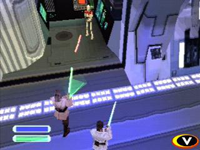
First of all, let me just say that I was very young when Star Wars: Episode 1 came out, so nostalgia has managed to overcome what would probably otherwise be hatred for the movie and characters (for instance, I had no problem with Jar Jar). With that said, the first 3D action game I ever played was the game by LucasArts, which was released slightly before the movie itself.

The game was praised for its high-quality sound effects and the use of music from the movie (and, in the case of the PC version that I had, I particularly liked that the title screen had some clips of the movie that would loop) and for its action sequences, but was faulted for many of these sequences being flawed. A review by Movies2GamesReviews points out a lot of the flaws, but in a particularly searing light. Personally, I didn't have a problem with the relatively simple style of the graphics, the lack of some music from the score (such as Duel of the Fates--I liked the Droid Invasion theme much more, anyway, and that's the song they kept reusing). Being 11 at the time, I didn't notice, or care. It's really funny to hear critics complaining about the difficulty of the game when I, as a prepubescent child, beat it over and over again.


What so many apparently overlooked was the various quirks of the game. For instance, as you can see in the above video, if you walk over the dung worms for awhile in the Tatooine city, everyone in the city will comment on how much you smell like crap. What was a completely unnecessary game aspect, but they added it just to make the game come alive. You've got to admire that. Another neat thing about the game is that it didn't hold your hand, for better or worse. Sometimes this meant some platforming puzzles that meant lots and lots of reloading (and on the old Pentium II, it meant a minute or two of an impatient kid waiting for the game to load), particularly in a later level where Obi-Wan has to jump between some kind of weird turbo-lift platforms in that oversized area where Qui-Gon and Darth Maul fight. It also meant that you could attack and kill an ally, and you would lose the game. The game didn't stop you from doing what you wanted, but it did have consequences.

Also, I should mention that destroying droids in the first level and slaughtering Mos Espa and everyone at the Boonta Eve Race is loads of fun.


True, the platforming is difficult, the fights can be hard, the light sabers don't automatically deflect bolts back to their source, some of the puzzles can be annoying, the levels where you have to guard another character piss me off, and some of it felt rushed, but I still like the game. I guess that's the burden of nostalgia.

Oh, and yes, the final boss is way too easy.

  • Windows 95 or 98

  • 200 MHz or faster CPU

  • 32 MB RAM

  • 4 MB PCI or AGP Direct 3D graphics accelerator

  • 16-bit sound card

  • DirectX 6.1

If you're interested in seeing what it was like, give the demo a try.

Saturday, July 19, 2008

Deus Ex Machinima

It was some years ago that I first came across the web series Red vs Blue. This was really my introduction into the world of machinima, and it was as gentle as being clubbed over the head with a lead pipe. This series was, for lack of a better phrase, FUCKIN' FANTASTIC! For those who are not aware, machinima is the practice of acting out a scene through a game and then superimposing sound, effects, etc. to make a film.

Titled the "Blood Gulch Chronicles", the first series of Red vs Blue takes place in a popular Halo map in which the players have two bases in a box canyon. Though the series started as mere comedy, it quickly grew to be an amazing masterpiece of storytelling, and the growing skill of the creators became more and more apparent. Basically, the videos were created by recording what a "camera character" saw while moving other characters around and later superimposing voices. Simple as it may sound, it takes a lot of effort and perseverance to keep a series like that going, and Red vs Blue made 100 full episodes in its first season, not including PSAs and specials.

I've just recently gone back to their website to see if anything is new, and indeed there is! A new season of Red vs Blue, titled Red vs Blue Reconstruction, has been made, and it absolutely blows my mind. Unlike the Blood Gulch Chronicles, this new series takes place in Halo 3, which means that it's only on the console. Yet, the guys at Rooster Teeth have somehow managed nearly cinematic-quality special effects.


Yeah, I'm gushing, but Jesus Christ, if you've not checked this stuff out, DO IT! Hell, buy the DVD Box Set if you have to in order to catch up--it's more than worth it. My only complaint is that Red vs Blue's creators have this prick notion that no one should be able to embed their videos. This is the Goddamn age of YouTube! Why the hell not? If someone embeds your videos, they're giving others a taste of what you've made, which only increases your own popularity! Quit that shit.

In addition, Rooster Teeth also created the machinima series "1-800-MAGIC" (based on Shadowrun), "The Strangerhood" (based on the Sims 2), "PANICS" (based on F.E.A.R.), and the Halo 3 mod, Grifball. They also run a regular webcomic about their team.

Another machinima series that I've really gotten into is Leet World, which is made using Counter Strike: Source. The series itself is presented like some kind of competition reality show between the terrorists and counter-terrorists, complete with hilarity and drama.


In Red vs Blue, nearly all the characters are either in SPARTAN suits or are awkwardly made to lip-sync (save in Reconstruction, where the lip-syncing is spot-on), so it never looks funny when you see someone talking (the characters just nod their heads to denote speech). In Leet World, however, a number of main characters' models weren't made with lip syncing in mind, so some of them with visible mouthes don't actually move them when talking (although the game show host, played by the G-man, is lip-synced quite superbly). It's interesting to compare and contrasts the different styles that Rooster Teeth Productions and Smooth Few Films use. I love it when everyday people don't let their inexperience hold them back from being creative.

With that said, I leave you with this amazing Half-Life 2 machinima music video of Breaking Benjamin's "So Cold" called "I'm Still Seeing Breen" by Paul Marino.

Tuesday, July 15, 2008

Virtual Reality is Gay

NOTE: This article contains satire and is not to be taken seriously.

Everyone knows that virtual reality "chat rooms" are really gaining momentum, what with Second Life, IMVU, and, most recently, Lively. Well, in light of such popularity, I decided to go out of my way to demonstrate the gayness of such virtual chat rooms.

Let's begin with Second Life. Now, since the beginning, I've said that, in order to have a second life, you had to have a first one to begin with. Most of these people apparently never did. It must take an addiction to keep someone coming back to this boring world.

First of all, let me say that the depth of Second Life's avatar customizations are very impressive. In what other game could I create the sexy abomination that you see before you?

Beyond that Sims 2-ish customization, however, there is honestly very little to do. I started out on the tutorial island (because I'm a n00b) and began going from place to place with the most godawful controls I could imagine. Not only was the client twitchy (either from CPU lag or from 'net lag) and caused my computer to overheat, but the character moved like he was as horrendously obese as he looks. I would have to stop, turn, and then move again, lest I end up running into some wall or object.

Next, I decided to go and test out driving a vehicle. Seeing an open Segway, I fiddled around with the controls until I finally persuaded my corpulent creation to hop on board. However, he took the order a bit to heart and apparently decided he would ride it like a bike with no seat.


It's at this point that I have to step back and applaud Linden Labs for creating the amazingly accurate NASA simulator that I found before myself. Of course, it wasn't actually supposed to simulate any NASA scenarios, but controlling my avatar in a vehicle felt just like handling a rover on the damn moon, control delay and all! Think of all the money that NASA can save in simulators by just putting a fat drag queen on a Segway.

It's at this point that I finally gave up, knowing from past experience that the people who inhabit Second Life aren't just in a virtual world, they're in their own virtual world, too. It's like the online asylum for the mentally dysfunctional--no one recognizes anyone else and instead just fiddle with objects in the world and talk to themselves.

Well, if that wasn't gay enough for you, just wait 'til you see IMVU.

I swear that this game was crafted by the hands of the great Gods of Gaydom and sent to Earth through the dreams of the biggest queers that inhabit the planet, because this little game is gay.

First, let us start with the little avatar that I quickly crafted from the very limited selection of available free parts. Now, the biggest problem with IMVU is that it's a huge money-making scheme. Well, all of these virtual reality programs are, but IMVU in particular wants you to spend real money for the privilege of having more parts to craft your avatar, so what you do get off-hand is the worst of what's available. Well, if you're straight, anyway.


I mean, look at the detail that went into this character's abdomen and upper hips, let alone the completely queer animations. Anyone who would find this stuff great has got problems.

Which ties me in nicely to my next point; many people on IMVU don't speak much English. Now, it's not that I have a problem with people who are from different cultures, but if you're in my country (or in a program hosted on a server located therein), you should speak MY damn language, bitch!


And, at last, on to the gayest of them all, Google's Lively.

Since this particular client is so openly, lispingly gay, I think that I can best describe things with pictures and captions.


My avatar; not a bad rendition of a cyborg bear, I might add.


Uh-oh, a "Free Sex" chat room. This is going downhill fast.


Naturally, it's a gay free sex chat room. I find all the placebo avatars particularly arousing.


I try my hand at the sexy Internet lingo, to prepare for the hot lovin' that's sure to be coming. Unfortunately, after five minutes of standing around, the room had still not loaded and I ditched it.


What's this? Another room? And with true love found so fast! Thank God gay marriage is legal in the wonderful land of Lively.


An awkward discovery of what's really on my new partner's mind. Did he accept my proposal just to bask in the pedophilic warmth of my furry body?


Reminding my partner about the ideals of hard love.


And so our two avatars live on happily ever after, faithfully bound by the unbreakable bond of matrimony.


OR DO THEY?!

Saturday, July 12, 2008

Star Wars: Droidworks


If I recall, Star Wars: Droidworks was the first game my parents purchased for me on our brand new Gateway computer ("4GB HDD! WOW! How can you fill SO MUCH SPACE?!") in '98. Since before that point, I'd only played early side-scroller computer games (with the exception of a brief taste of Wolfenstein 3D), Droidworks really captured my fascination. Besides, at that point, we only had some very weak television (just enough to get PBS) and Star Wars was the only science fiction I knew of.


The game consists of one creating "droids" by combining various parts and then painting them as you desired. There were a number of missions that one needed to complete, some requiring very specific droid specs, such as being magnetic. And here Maxis thought that they did it first.

Quaint as the game may now appear to be, I loved it, and I believe that I learned quite a bit from it as well. Note, this is back when I was just beginning to really read (and before I found any fascination in books), and still had but very rudimentary mathematics skills (so in order to finish the puzzles concerning angles and such things, I had to devise a system to work out the correct answer without actually understanding how it all worked--or use trial and error). The game also helped initiate my love for sci-fi and robots.

System Requirements:

  • Windows 95 or 98

  • Pentium 133MHz

  • 16MB RAM; 32MB recommended

  • Minimum 34MB hard disk space

  • 4X IDE or SCSI CD-ROM

  • 100% Direct X compatible PCI graphics card

  • 100% DirectX compatible 16 bit sound device


If you'd like to give the game a whirl, try out the demo or buy it.

Friday, July 11, 2008

That Dark Quality

So the other day I was going through Drow Tales (a [fantastic] comic I've mentioned in a previous post), trying to catch up, and I came across a certain flash video made by the artists to celebrate the new year. I was stunned.

Why? Well, because it reminded me so much of the kinds of opening cutscenes that played a huge part in making the Thief series freakin' fantastic!


As a frequent reader would know from a previous post, there are a few themes that really snatch my fascination. Let me lay them out here, along with how I got them:

1. 30s to 60s culture - Fallout, Bioshock, classic musicales

2. Futuristic Sci-fi - Star Trek, Star Wars, the Ender's Game series, Commander Keen series, Starcraft

3. Post-Apocalyptic Themes - Fallout, The Stand, Exmortis 1 and Exmortis 2, Solar Flare, Resident Evil series

4. Fantasy - Lord of the Rings series, Chronicles of Narnia, Nox, Arcanum: Of Steamworks and Magick Obscura, various Dungeons and Dragons computer games

5. Steampunk - Arcanum: Of Steamworks and Magick Obscura, Thief, Bioshock

Now, on to Thief itself.

One of the most fantastic aspects of the series (the first and second in particular, especially Thief 2: The Metal Age, as that was the first I played) was the immersive atmosphere. Its gothic themes (in particular the mix of magic and technology) really brought the game to life for me. Each level (of Thief 1 and 2) would be preceded with a cutscene where Garrett, the protagonist that one plays as, would discuss what needed to be done. The music, the style of the intro art, it all works together to help one feel that they are a true part of this world (and when the graphics look like this, you need great gameplay, a fascinating story, and deep immersion to keep the player intersted).


The series was developed by Looking Glass Studios (rest in peace) for Thief: The Dark Project/Gold and Thief 2: The Metal Age (the creators of the System Shock series) and Ion Storm (rest in peace) for Thief: Deadly Shadows (also the creators of the Deus Ex series). It was the first "first person sneaker" game ever, making use of a heavily-modified version of the first Unreal engine (from the original Unreal Tournament) to create shadows one could "hide" in, as well as the unprecedented "AI hearing" capability (depending on what surface you walked on and how quickly you walked, your footsteps would make a certain amount of noise which could alert nearby AI to your presence). Now, I've Splinter Cell series and tried sneaking part of the Elder Scrolls series, and let me tell you, none of them hold a candle to these classics.


Of the Thief series, Thief 2: The Metal Age was, hands down, my favorite. Thief: The Dark Project/Gold, while loads of fun, were a lot more about being spooked (which is cool) and fighting hordes of monsters, and Thief: Deadly Shadows was much more about the action, choices, etc. In contrast, not only did Thief 2 have the steampunk theme that the others lacked, but it also pitted the player against mostly human enemies, which meant real sneaking. There is very little more satisfying than successfully sneaking through a Thief 2 level, stealing loot, without any of the AI noticing.


By the way, that's another thing that added a lot to the immersion; the AI dialog.


Is there some Monty Python reference in here? I've never seen the movie, so I can't say. Regardless, it's these kind of conversations and situations that one "stumbles upon" that really makes it come to life. That and, of course, the dark, gothic atmosphere.


As seen in the above video, enemies can sometimes really surprise you, and while the shadows and directional audio can help you in your sneaking, it can also obscure enemies and make you unsure of exactly where those loud moans are coming from.


I'm not alone in my love of the Thief series. In fact, even ten years after the series began, there is still a thriving fan community for this game, mostly making fan missions.

Speaking of fan missions, some fans got together and created an unofficial expansion pack for Thief 2: The Metal Age called Thief 2X: Shadows of the Metal Age, which is, in my option, the absolute best fan-made work ever. It is a great example of professional quality in amateurs, and, honestly, almost as good as Thief 2 itself. Even the Thief2X website looks great; I love that gothic design. The expansion pack is free to download, though it requires an installation of Thief 2 in order to work.


Thief: The Dark Project

  • Windows 95

  • 166 MHz CPU

  • 32 MB RAM

  • 4 MB PCI or AGP Direct 3D graphics accelerator

  • 42 MB available HDD space

  • DirectX 6.0


Thief 2: The Metal Age
  • Windows 95

  • 266 MHz CPU

  • 48 MB RAM

  • 8 Mb PCI or AGP Direct 3D graphics accelerator

  • 250 MB available HDD space

  • DirectX 7.0


Thief: Deadly Shadows
  • Windows XP

  • 1.5 GHz CPU

  • 256 MB RAM

  • 64 Mb Video Card with Pixel Shader 2.0

  • 3 Gb available HDD space

  • DirectX 9.0b


In summary, if you haven't played these fantastic games, buy them (or even download them) and do so. If the games themselves aren't enough, then the (literally) hundreds of fan-made missions should be. At the least, try one of the demos.

Wednesday, July 9, 2008

If God Dropped Acid

NOTE: This article contains satire and is not to be taken seriously.

Although the Spore Creature Creator has been out since the 17th of June, only now am I finally ready to express my deepest thoughts concerning this let-down of galactic proportions.


Before we go on to the creature creator, let's start with Spore itself. First shown in depth during the 2005 GDC (presentation embedded below), Spore quickly became a matter of excitement amongst gamers who enjoyed the kinds of creation games that Maxis (via Will Wright) is known for (myself included). Wow! Such a gigantic game, with the ability for players to create pretty much everything! It was unprecedented.


Since then, the game evolved, becoming more refined, parts were added, parts were taken out, and those of us who first were excited continued to look on with that same childlike wonder. Then, to our delight, it was announced that the entire creature phase editor would be released as a demo of the game. By far, the creature creator looked like the best editor in the game, and people (again, myself included) were pissing their pants to get their hands on it.

June 17th game and it was officially released. The editor came in two parts: a free editor that had about 25% of the parts available, and the full editor, which was just ten dollars. I had initially pre-ordered it on Amazon, but couldn't wait and so bought it again for direct download.


It was all I'd imagined! I could create pretty much anything I could come up with, and the editor would bring it to life. There were three parts to the editor: the parts tab, the skin tab, and the test drive tab. They allowed one to build their creature, specify its texture, and try it out, respectively. The procedural generation of texture wrapping was, for the most part, all that had been hyped--the computer did a damn fine job.

The problem came when you brought your five-footed beast with a mouth on its ass and eyes for nipples into the test drive area. In spite of how nice the procedural texturing was, the procedural animation was... eh... not quite up to par.


In fact, that is an understatement. It SUCKED. Sure, bipeds worked almost perfectly, and quadrupeds were just fine as long as the back feet didn't step through the front feet (on account of a lack of any kind of collision detection). The real problems arise when you add more legs or an uneven number of legs (such as two in the back and one in the front, or vice versa). Most often, either the leg will be bent in such a way that it doesn't move in a useful way (such as the single hind leg dragging behind the first two--user error, since such a leg would realistically be useless), or the legs bend and twist in horrid, deformed ways as it performs various animations (program error).

Most creature creator artists (many of which are very, very talented) don't care about the animation--it's all about how it looks, but what's important to keep in mind is that the creatures that are made and uploaded to the Sporepedia (that's right--the huge database of creatures that, when the game is released, will be used to randomly populate Spore's galaxies) will have to be animated at some point, or else it's useless to have them there. Many artists have (with much skill, I might add) used the tools of the creature creator to recreate animals, vehicles, foods, etc., forgetting that the whole point of the creator is to make never-before-seen creatures to populate never-before-seen worlds. Not to create things we're familiar with so that some gamer will encounter a planet full of t-rexes, a planet full of crawling creature-airplanes, and a planet full of penises (oh, yeah--I forgot to mention the Sporn).

Which brings me nicely to my next gripe. As of my writing this article, there are over 1.5 million creatures in the Sporepedia, and for every (these are Maxis-approved featured creatures, by the way) Cerebrilith, Cinke Deepdigger, and Orbanid, there are ten Lawn Gnomes, Strawberries, or Maxises, and that's my biggest complaint. Of all the problems that have come before, my biggest is that most creatures that will be randomly chosen to populate my Spore universe are absolute SHIT. Now, I'm not saying that I'm some kind of genius of creative creature design (far to the contrary, though, in my defense, I can't stand bad animations or excessive clipping, thus vastly limiting my creative options), but Jesus Christ Almighty, don't most of these people even TRY to make their creation look presentable?

I know that I've thrown away far more creatures than I've made, and have later even thrown away finished works that I later decided were poor. If anything, I'd rather have creatures of consistent quality in not only looks, but animation and functionality as well, thus making myself a good candidate for "subscribed content" (in the full Spore game, one will be able to filter the creatures that populate their universe by the users that created them). So maybe they're not the prettiest creatures, but they work and, for the most part, make aesthetic and realistic sense.

On the other hand, most other users seem not only to give no thought to the point of their creatures, but also have an immature attitude to match their creative ability (I've many times gotten thumbs-down votes on all my creatures for giving someone creative criticism). When you get down to it, the biggest thing that sucks about Spore (as it is thus far) is that it's an MMO game (regardless of what Will Wright said about it being "massively single-player"), which means that the idiotic and immature scum of society buzz around it like flies around a cow's asshole, and let me tell you, there is nothing that kills my creative urges like a whiny prick.

What's most spectacular is that the creatures in the very first image of this article are actually possible in the editor (though posing them in that manner is not), so why don't more people try to keep their creatures looking good, like that? Also, I think it's kind of funny that they're all bipeds with their eyes above their mouthes--if it's done any other way (for the most part), the animation turns out to be crap, and if it isn't crap in the test drive, I'm guessing that it will be crap in the full game, when the creature oddly bends its head/neck so that it can actually eat with its mouth.

On top of all of that, the game has a number of annoying bugs, such as forgetting the creatures that one has made, or not importing the .png files carrying the creature code properly.

So here I am, out twenty bucks (that could better be spent on WALL-E movie tickets, to fuel my unhealthy obsession). Yet another Maxis/EA product that is fun for about five hours, then quickly loses its thrill. Maybe I'm missing the awesome Web 2.0 thrill that is the creature creator, but I'm not particularly impressed by what I see.


Additional links: Sporesite